

Two Blocks from a Catastrophe
Maybe it was the movie. Maybe it was the actress I’d already dismissed. Maybe it was the theater that came back to life. I’ve stopped trying to choose.

The walk from my front door to the theater takes two minutes. Two blocks. I have made it so many times that the theater might as well be an extension of my living room — a fourteen-screen annex where the couch seats strangers.
For a long time, that was a grim joke. The place was a ghost town: twenty-four employees rattling around a building meant for a staff three times that size, a kitchen that didn’t work, screens flickering for audiences that never came. Then, two months ago, a new owner took over, and the theater began the kind of quiet resurrection that never makes the news. The kitchen got fixed. The floors got clean. The staff grew from twenty-four to eighty-nine, and — harder to quantify but impossible to miss — the employees started smiling and the patrons started laughing. An institution nobody was tending was suddenly being tended.

So on June 27 at 1:40 p.m., when I made the two-minute walk to see Supergirl, I was rooting for the building more than the movie. The film arrived pre-convicted: a $37 million opening against a budget somewhere north of $170 million, critics shrugging at 56 percent, and a discourse that had already sorted itself into the usual trenches — one side blaming misogyny, the other blaming Hollywood, everyone certain, nobody in a theater.
For the first fifteen minutes, I was ready to join them. The movie opens wrong, or so I thought: Kara Zor-El hungover in a wrecked spaceship, drinking flaming shots in an alien bar, a traumatized young woman playing at oblivion. This wasn’t the Supergirl I expected, and Milly Alcock — who had left me cold in House of the Dragon — seemed like the wrong actress to carry her. I sat in the dark with my arms crossed, a one-man B-minus CinemaScore.
I was wrong on both counts, and it took roughly fifteen minutes to find out. The turn came when Kara’s dog Krypto was attacked, and Kara — this armored, flippant, self-medicating Kara — pulled her dog into her arms. The oblivion act collapsed. Underneath it was someone who had lost everything and could not survive losing one thing more.
That was the moment the opening reorganized itself in my memory. The hangover, the flaming shots, the wrecked spaceship — I had read them as the film not knowing who its hero was. They were the opposite: the film knowing exactly who she was, and trusting me to catch up. Kara Zor-El is not her cousin. Kal-El left Krypton an infant; he grieves an idea. Kara was old enough to watch it die. The partying wasn’t a tonal miscalculation. It was a symptom. The movie opens the way trauma actually presents — not as tasteful sadness but as noise, avoidance, a person performing fine at high volume.
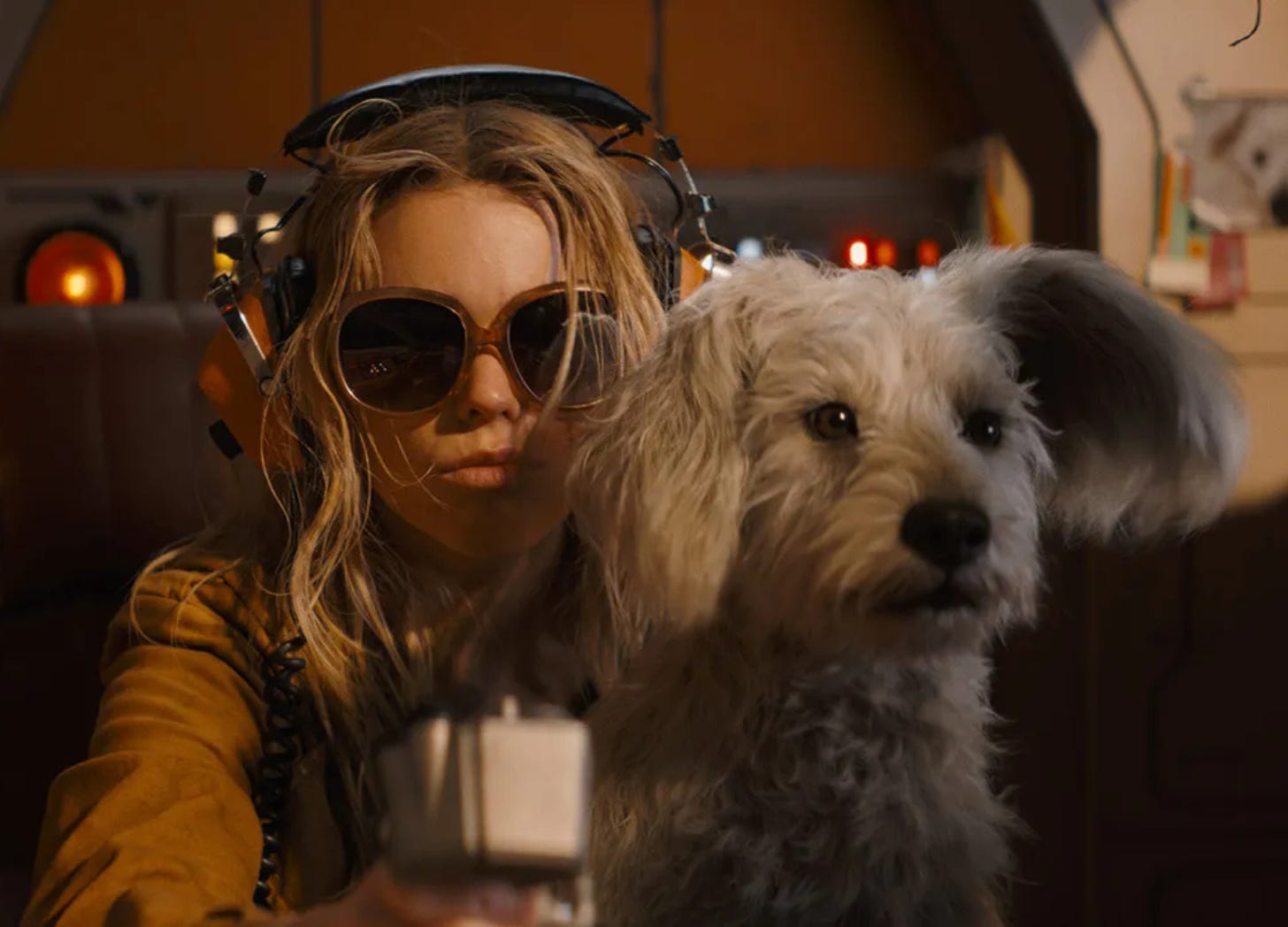
And Alcock, who I’d found forgettable in House of the Dragon, turned out to be the only kind of actress who could play it. The performance is reserved in a way the marketing never suggested — the brashness sits on top of something held very still underneath, and the film’s best moments are the ones where the top layer slips, as when Kara tells Ruthye that vengeance will not take her pain away or bring her family back, and that killing will stay with her forever. She then urges her to choose a better path: “your heart is still good and open. Your life will be your revenge.”
Later in the movie, Kara takes a sword made by Ruthye’s dead father and shoves the blade into Krem’s stomach and says “this is for my dog” and then thrusts it into his neck and says “this is for what you did to that little girl.” And that is how trauma is: messy, tangled, convoluted and often better at preparing us to save others than to save ourselves.
A critic at ScreenRant confessed that Kara’s grief brought her to tears even as she rated the film a six out of ten. That gap — moved to tears, six out of ten — may be the most honest review the movie got, and it points at something the scores can’t hold.
Which raises the question I walked home with: if the movie was working on me — arms uncrossed somewhere in the first act, fully surrendered by the end — why did every instrument we use to measure movies say it failed?
The instruments certainly agreed with each other. A B-minus CinemaScore. Fifty-six percent from the critics on Rotten Tomatoes. A projected loss that Variety needed the word “super-horrendous” to describe. Within days, DC’s own co-chief was conceding the film “didn’t meet our box office expectations” — the studio equivalent of a eulogy.
And the discourse, as discourse does, immediately knew why. The New York Times saw misogyny — and there was real misogyny to see: Alcock spent the spring absorbing abuse from anonymous accounts before anyone had watched a frame. Fox saw wokeness — an actress who mused about her character’s queerness during Pride month, a studio that made a movie, as Alcock put it herself, not “centered around a man, it’s not centered around love at all.” The trades saw a demographic miss: a film built for Gen Z women that opened to an audience 59 percent male and 65 percent over twenty-five. Each trench had its evidence. Each explanation had the advantage of requiring no one to sit in a theater.
Here is what the theater couldn’t tell you but the reporting later did: the movie I watched barely survived its own making. The Hollywood Reporter‘s Borys Kit pieced together the post-production — test scores that never escaped the 60s, and a March “bakeoff” in which the studio screened its own cut against director Craig Gillespie’s, back-to-back, for audiences whose scores dropped under the weight of the exercise. The studio’s version won by two points. Two points. The film that arrived in my theater was a coin flip that landed one way. It was a hair’s breath from being a different movie. I, for one, am glad I got to meet Alock’s Kara Zor-El.
Even the movie’s most mocked decision was its most agonized. That cover of “The Middle” — the needle drop one viral post crowned the worst of all time, the one a critic said made him disintegrate in his seat — replaced a cover of Cyndi Lauper’s “Girls Just Want to Have Fun” that had actually played in a test cut. James Gunn chose the Lauper. Then James Gunn took it out and chose the Jimmy Eat World cover instead, in a decision Gillespie called probably the biggest discussion of post-production, settled in the final week, with some forty-five candidates tested against the scene. The internet’s shorthand for the film’s carelessness was, in fact, the single most deliberated choice in it. Gunn had the cheap, crowd-pleasing needle drop in his hand — the song that would have flattened a grieving woman into a fun one — and he put it down.
I don’t cite any of this to argue the movie was secretly a masterpiece the suits ruined; Gillespie’s cut tested only marginally differently, and no version ever thrilled a scorecard. I cite it because of what it reveals about the instruments. The test screenings measured two cuts against each other and found two points of daylight. The box office measured who showed up in the first seventy-two hours. CinemaScore measured the exit mood of opening-night diehards. Rotten Tomatoes averaged the thumbs of critics — one of whom, remember, cried and scored it a six. Every instrument returned a reading, and every reading was probably accurate. Not one of them measured the thing that happened fifteen minutes in, when a woman playing at oblivion pulled her dog into her arms and a man in row F uncrossed his.
That thing doesn’t happen on a spreadsheet. It happens in a room. Which brings me back to the building.
I have loved movie theaters all my life for a reason I only recently learned to name. A theater gives you the benefits of human proximity without the anxiety of a formal social obligation. It is not a networking event or a dinner party; nothing is required of you. And yet you are undeniably among people — you hear them gasp, you watch them lean forward, you catch a stranger wiping their eyes in the light of the screen. In an age when most of our encounters with other humans arrive filtered through algorithms and flattened onto screens, a theater is one of the last rooms where you witness unedited, real-time human reaction. You see people get excited. You see them eat. You see them relax. As the world becomes more virtual, the old brick-and-mortar cinema is quietly becoming one of the most radical places left to stay connected to your own humanity.
But a room can only do that if someone tends it. For years, mine couldn’t — you cannot feel shared humanity in a ghost town. What the new owner restored was not just the kitchen and the floors but the conditions for the thing itself. The employees smile now, and it does not read as corporate policy. One of them stopped me on an earlier visit to see Backrooms and told me, unprompted, that “it has become so much better” under the new owners. Eighty-nine people work in a building where twenty-four used to hide. That is not a business story. That is an institution coming back to life, and everyone in it can feel the difference — which may be why the patrons laugh more freely, and why a man watching a grieving alien hug her dog found his arms uncrossing.
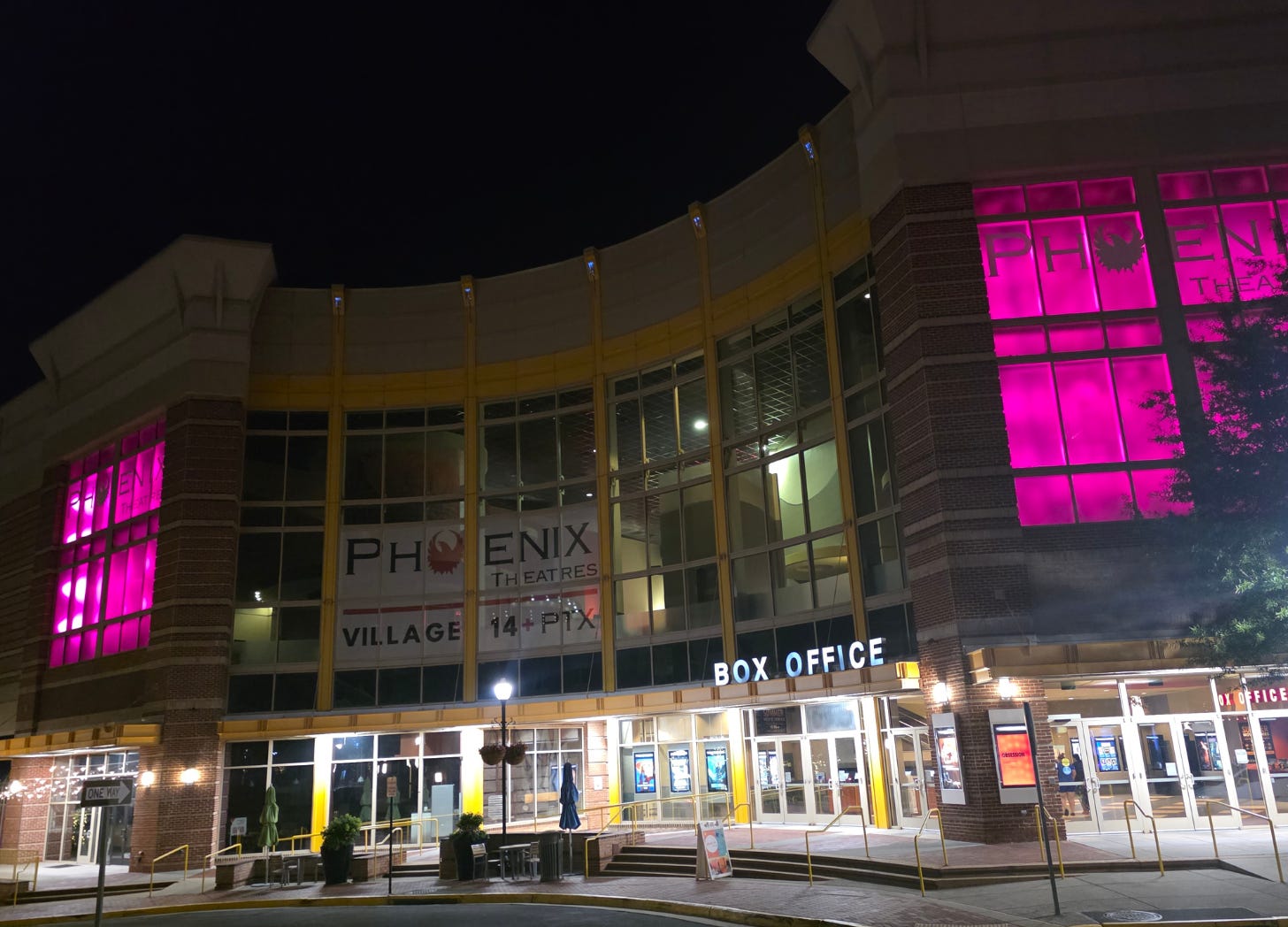
I should be honest about the variables, because I have run this experiment before. In the past two-and-a-half years, in this same theater, I saw Backrooms, Disclosure Day, Michael, Thunderbolts, Conclave, The Fall Guy, Abigail, Civil War, and Captain America: Brave New World. None of them did this to me. Not one sent me back the next morning. So I cannot cleanly tell you what happened on June 27. Maybe it was the theater, newly alive. Maybe it was me, arriving at the right moment for a story about grief wearing a party costume. Maybe it was Alcock, an actress I had dismissed once already. Maybe it was simply the movie. The honest answer — the one no thinkpiece will give you, because it doesn’t win arguments — is that I cannot isolate the variable, and I have stopped wanting to. Meaning is usually overdetermined. That is how you know it’s real.
Here is the part I have not told you. That Saturday afternoon was not my only viewing. I went back that evening. Then Sunday morning. Then Friday. Then tonight — I am writing this with the ticket stub from my fifth showing beside me. Somewhere in the $37 million everyone agrees is a catastrophe, there are five tickets that belong to me, invisible to every instrument that declared the movie a failure. The numbers counted me. They just couldn’t see me.
The walk home takes two minutes. Two blocks. Tonight, when I got inside, I hung my keys on the wall and played “The Middle” — the maligned version, the slow one.
Jayson Blair is the host of the Silver Linings Handbook podcast and a former reporter for the Boston Globe and The New York Times.